
How Long to Become a Diagnostic Medical Sonographer
Published - May 12, 2026
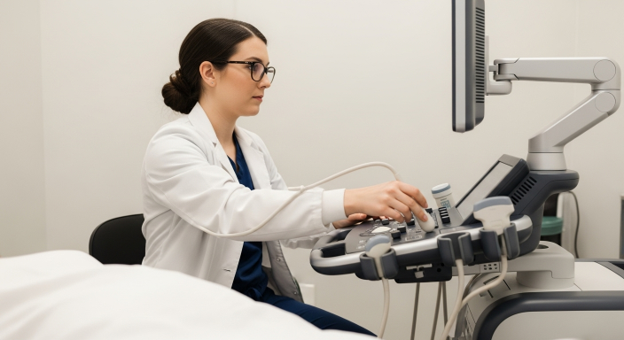
Table of Contents
Most people learn how to become a sonographer in about two years through an accredited associate degree, then earn certification through the American Registry for Diagnostic Medical Sonography (ARDMS®). Diagnostic medical sonographers earned a median annual wage of $89,340 in May 2024, and the field is projected to grow much faster than average through 2034. The timeline depends on three things:
- The degree path you choose, typically a two-year associate degree
- The clinical hours your program requires
- How quickly you sit for the ARDMS exams after graduating
Each piece adds time, and the order you tackle them in shapes how soon you can start working.
A diagnostic medical sonographer, also called an ultrasound technician, operates equipment that uses high-frequency sound waves to produce images of organs, blood vessels, soft tissue, and developing fetuses. Physicians use those images to diagnose and monitor conditions without invasive procedures. Because ultrasound uses no ionizing radiation, the work centers on image quality, patient positioning, and direct interaction during exams.
What a Diagnostic Medical Sonographer Does
The role pairs technical skill with hands-on patient care. A typical shift involves several distinct tasks:
- Review patient history and explain the exam before it begins
- Position patients and apply the transducer to capture target images
- Adjust equipment settings and recognize normal from abnormal findings
- Document images and summarize findings for the interpreting physician
Sonographers often specialize in areas such as abdominal, obstetric and gynecologic, vascular, or cardiac imaging. Each specialty carries its own ARDMS examination and, in some cases, higher pay.
Understanding the full scope helps before committing to a program. A guide to what an ultrasound technician does breaks down the day-to-day responsibilities across settings, from hospitals to outpatient imaging centers.
Step 1: Earn an Accredited Degree
The standard entry point is an associate degree in diagnostic medical sonography, which most students complete in about two years. Employers and certifying bodies expect graduates of programmatically accredited programs, so accreditation matters when choosing a school.
CBD College offers a Diagnostic Medical Sonography program that combines classroom instruction in physics, anatomy, and scanning technique with the clinical hours certification requires. The curriculum prepares students for the ARDMS examinations that lead to the Registered Diagnostic Medical Sonographer (RDMS®) credential.
Coursework covers more than equipment operation. The skills built in a sonography program range from cross-sectional anatomy to patient communication, and a review of sonography technician training shows how those skills develop across the program.
Step 2: Complete Clinical Training
Classroom theory becomes job-ready skill during clinical rotations. Students complete supervised hours at hospitals and imaging centers, scanning real patients under the guidance of working sonographers. These hours are where students refine probe handling, learn to capture diagnostic-quality images, and adapt to the pace of a clinical environment.
Knowing what to expect from rotations eases the transition. A guide to the clinical externship experience walks through the day-to-day reality of working in a clinical setting, from patient interaction to documentation. The number of clinical hours a program builds in is one of the biggest factors in how long the overall path takes.
Step 3: Pass the ARDMS Certification Exams
Certification is what most employers look for. The RDMS credential requires passing two examinations: the Sonography Principles and Instrumentation (SPI) exam and at least one corresponding specialty exam, such as abdomen or obstetrics and gynecology.
You can take the two exams in either order, but ARDMS applies a five-year rule: you must pass the second exam within five years of passing the first. First-time applicants choose a prerequisite pathway that matches their education and clinical experience, then apply under it.
Many states and employers require certification before hire, and requirements vary. Confirm the rules with your state and target employers before you apply for jobs.
Salary and Job Outlook
The pay reflects steady demand for skilled imaging professionals. Diagnostic medical sonographers earned a median wage of $89,340 in May 2024, with the lowest 10 percent earning under $64,760 and the highest 10 percent earning above $123,170. Hospitals, physician offices, and outpatient care centers employ the largest share of sonographers.
Demand is strong. The Bureau of Labor Statistics projects employment of diagnostic medical sonographers to grow 13 percent from 2024 to 2034, much faster than the average across all occupations, with roughly 5,800 openings each year over the decade. An aging population and the shift toward noninvasive imaging drive much of that growth.
For a closer look at how earnings shift by region, setting, and specialty, see the current sonography salary trends.
How Long the Full Path Takes
For a student starting from scratch, the timeline runs about two years through an associate degree program, including clinical hours, followed by the ARDMS application and exams. Testing soon after graduation, while coursework is fresh, keeps the total time down.
Three variables change your timeline:
- The program format you choose and how it schedules clinical hours
- Whether you pursue a single specialty or add more credentials
- How soon you sit for the SPI and specialty exams after finishing the program
Planning the exam sequence early keeps the ARDMS five-year window from becoming a constraint as you add specialties later in your career.
Start Your Sonography Career at CBD College
If you are ready to move from researching the field to training for it, CBD College’s Diagnostic Medical Sonography program combines classroom instruction, clinical placement, and ARDMS exam preparation in one accredited track. Review the steps to become a sonographer to see how the program fits your goals, then connect with an admissions advisor to map out your enrollment.

